

Kidney Stones: Symptoms, Causes, and Treatment Options Explained.
Let’s get started. Okay, a very good evening to everyone with us. I’m sure a lot more people will be joining in very soon. I am Dr. Yusuf Saifee, I’m a Urologist & Kidney Transplant Surgeon presently practicing at Vishesh Jupiter Hospital in Indore, and I also visit Saifee and Apollo Hospitals in Mumbai every week for OPD and surgeries.
Today I’ll be talking about kidney stones. This blog is aimed for the common public. It’s for public awareness, and I’m sure at the end of this read all of you will have something to take home, something added to your knowledge of kidney stones, and you’ll better know how to prevent kidney stones and, if you do have them, how to get treatment and get them removed from your body—whether you are looking for kidney stone surgery at Indore or kidney stone surgery at Mumbai.
What Are Kidney Stones?
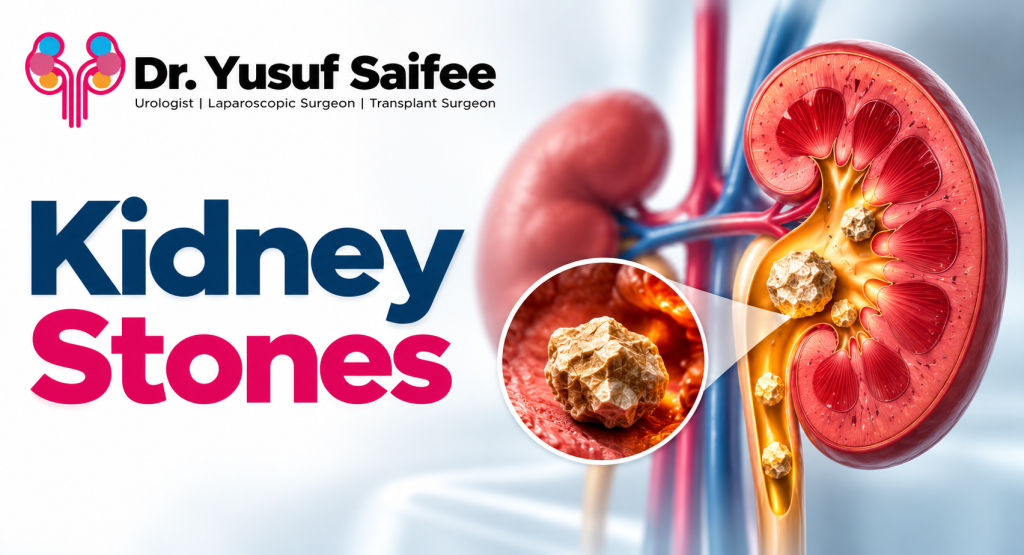
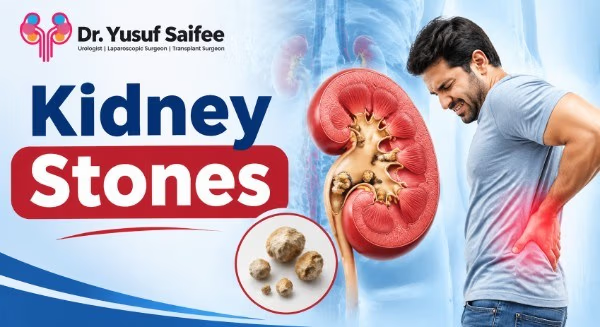
All right, so what are kidney stones? The urine contains a lot of minerals and salts dissolved in it, and there are multiple factors which are responsible for the dissolution of these elements in the urine and crystallization of these elements out of the urine. Stone formation occurs when the delicate balance between the dissolution factors and crystallization factors is disturbed.
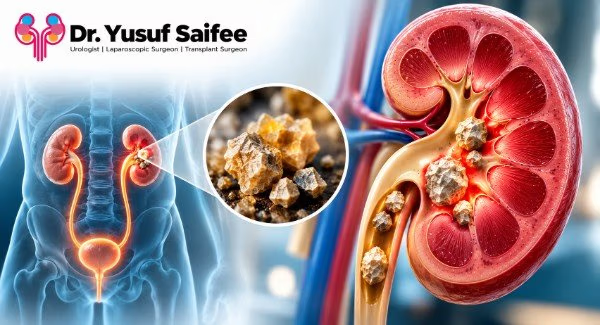
So when these minerals and salts get crystallized, they lead to the formation of stones. Stones can be formed anywhere in the urinary tract. It could be in the kidneys, it could be in the narrow tube that connects the kidneys to the bladder (called the ureter), and it could be formed in the bladder as well.
We will discuss kidney stones under six headings today: one, the symptoms of kidney stones; two, what are the stones made of; three, what are the causes; four, how do you get diagnosed; five, what are the treatment options available in the present world; and six, how to prevent further formation. So let’s get started.
Symptoms of Kidney Stones
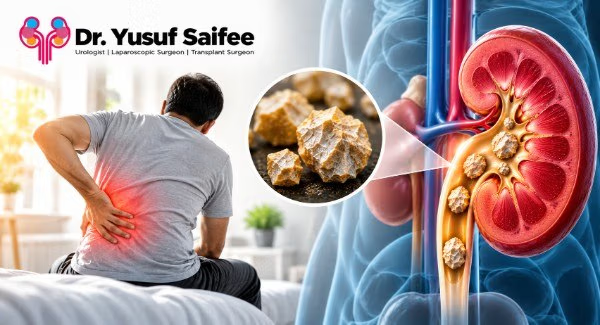
The first and foremost thing that brings a person to the doctor’s office is excruciating pain. This pain is usually very sudden in onset, it’s located on what we call the side or the back (it’s called a flank pain), it usually comes on very suddenly, and it is usually very severe. There’s no particular posture in which you feel relieved and you usually need medications and painkillers to get rid of this pain. Sometimes this pain moves from its original location down into the groin, it could be radiated to the medial aspect of the thigh, and sometimes it is also perceived at the tip of the penis in men and at the sides of the labia in women.
Along with this, there may be an intense urge to urinate. This is also due to a stone usually located in the ureter. Another symptom can be the need to go to the bathroom more often than normal. Sometimes one can see blood in the urine; it could be dark red or it could be fresh blood, and there may be clots as well. When stones are obstructing any part of the urinary tract, it may cause nausea and vomiting. If there is a secondary infection, it may lead to features of sepsis like fever. If you experience these red flags, seeking evaluation from the best urologist at Indore or the best urologist at Mumbai should be your immediate next step.
What Are These Stones Made Of?
As most people would know, 80 to 90 percent of stones are made of calcium. Calcium stones are the most common type of stones in the urinary tract. They can be calcium oxalate (the most common type) and also calcium phosphate. It is basically the type of mineral with which calcium combines. These stones can be located anywhere in the urinary tract, usually forming in the kidneys, while the smaller ones sometimes make their way into the water pipe and get blocked there.
The second type of stones are uric acid stones. These are usually 5 to 10 percent of cases. Uric acid stones can be formed in people who have high uric acid levels; they may have bone pain or joint pains what we call gout, but they may be formed even in the absence of joint pathology. Uric acid stones usually form in acidic urine. Being overweight, suffering from chronic diarrhea, being a diabetic, or suffering from gout are all causes of a more acidic urine.
The third type are struvite stones, what we call infection stones. These are comparatively more common in India and Southeast Asia. One of the reasons these stones form is the occurrence of recurrent urinary tract infections. One of the organisms, namely Proteus, causes the urine to become alkaline. The main chemical constituent is magnesium ammonium phosphate (triple phosphate), and these stones usually attain really large sizes. Some of the big stones formed in the kidneys that attain the shape of the kidney’s collecting system are known as staghorn stones.
Another less common type are cystine stones. These are usually formed in people with a metabolic disorder called cystinuria. These are relatively rare, accounting for about one percent of cases.
Causes of Kidney Stones
Point number one, and probably the single most important thing that I want to emphasize, is low urine volume. You need to understand that it’s the urine volume that we’re talking about, and not just the amount of water you’re drinking or the kind of environment you’re living in. You need to have a good urine output of at least two and a half liters every day. A very good way of knowing your relative state of hydration is the color of your urine—it is supposed to be very clear, pale straw-colored. If it is getting high-colored, you’re dehydrated.
A lot of people tell me, “I sit in an air-conditioned room all the time, I hardly do any labor, I hardly sweat, so why do I need to drink that much water?” Whether you’re working in the sun or seated in an AC room throughout the day, your body is losing a lot of water through your skin (insensible water loss). You need to develop the habit of drinking a glass every hour. A good fluid intake for the kind of weather we have in India would definitely be 2.5 to 3 liters.
In diet, I would like to emphasize consuming more fruits and vegetables. Animal proteins—primarily red meat, pork, beef, chicken, fish—make your urine more acidic and increase the risk. Among fruits and vegetables, you need to be careful about high-oxalate foods. The most common culprits are beans, berries, coffee, chocolate, and nuts. So if you’re having a big bar of nutty chocolate along with a large mug of coffee, it’s not a great idea. Spinach is also very high in oxalate.
Other causes include certain bowel conditions (diarrhea, Crohn’s disease, ulcerative colitis, or gastric bypass surgery) because the absorption of various minerals is hampered. Obesity is another massive risk factor; obese people have more acidic urine and more oxalate. Metabolic syndrome, hyperparathyroidism, and medications like high-dose Vitamin C tablets can also increase your risk. Finally, a family history of kidney stones gives you a genetic predisposition.
Diagnosis
Can you have a stone without knowing about it? Yes, absolutely. A person gets diagnosed with kidney stones when they undergo imaging for some other problem. An x-ray or an ultrasound scan picks up a small stone, and then they are referred to a urologist. This is because the stone is sitting at a location where it is not causing any obstruction, infection, or pain.
If you are consulting a urologist for symptoms, you’ll likely undergo an imaging test. 80 to 90 percent of stones are visible on a plain KUB x-ray. Ultrasound scans pick up some silent stones and any swelling or dilatation of the kidney. However, the most sensitive test is a CT scan. It gives precise information about the number, location, and density of the stones, helping us plan the right treatment.
Treatment Options
The treatment of kidney stones is totally dependent upon the number of stones, size, location, and your health condition.
The first option is wait and watch. If a stone is small enough to pass on its own in the absence of pain or complications, watchful waiting for four to six weeks is a standard strategy.
The second is medications, or medical expulsive therapy. This includes medicines that help relax the ureter alongside painkillers to decrease inflammation, paired with heavy hydration (3 to 3.5 liters) to flush the stone out.
The next treatment option is intervention in the form of surgery—such as advanced kidney stone laser surgery, RIRS surgery at Indore, RIRS surgery at Mumbai, or PCNL surgery at Indore—or in the form of shock wave lithotripsy. Shockwave lithotripsy uses waves emitted by a machine focused onto the stone to cause vibration and breakage. Once broken into sand-like particles, the patient drinks plenty of fluids and passes them over a week or two. It is usually a daycare procedure done under local anesthetic depending on tolerability, and you can go home the same day with certain medications.
Frequently Asked Questions (FAQs)
1. What are the first signs of kidney stones?
Sudden, severe pain in the back or side is a common symptom. Other signs include blood in urine, burning urination, nausea, and frequent urination.
2. What causes kidney stones to form?
Kidney stones develop when minerals and salts crystallize in urine. Dehydration, dietary habits, obesity, metabolic disorders, and family history can increase the risk.
3. Can kidney stones be present without any symptoms?
Yes. Small kidney stones may remain unnoticed for years and are often discovered during an ultrasound or CT scan performed for another reason.
4. Can kidney stones pass naturally without surgery?
Yes. Small stones, particularly those in the ureter, may pass naturally. The chances depend on the stone’s size, location, and whether it causes obstruction or infection.
5. Which test is best for diagnosing kidney stones?
A non-contrast CT scan is generally the most accurate test for detecting urinary stones. Ultrasound is also commonly used, particularly when radiation exposure should be avoided.
6. Does every kidney stone require surgery?
No. Small, uncomplicated stones may be managed with observation or medication. Larger stones, persistent obstruction, severe pain, or complications may require intervention.
7. What are the treatment options for kidney stones?
Treatment options include observation, medication, shock wave lithotripsy (ESWL), ureteroscopy (URS), RIRS, and PCNL. The choice depends on the stone’s size, location, and clinical condition.
8. How much water should I drink to prevent kidney stones?
Most stone-formers should drink enough fluids to produce approximately 2–2.5 litres of urine daily. Fluid requirements vary with climate, activity, and medical conditions.
9. What foods should I avoid if I have kidney stones?
Reduce excess salt, excessive animal protein, and high-oxalate foods if advised. Dietary restrictions depend on the type of stone. Normal dietary calcium should generally be maintained.
10. When is a kidney stone considered an emergency?
A kidney stone accompanied by fever, chills, inability to urinate, or severe uncontrolled pain requires urgent medical attention. An infected, obstructed kidney can be dangerous.