
Treatment of Kidney Cancer – Stages & Surgical Options
In the last article, we spoke about the symptoms and causes of Kidney Cancer. But, before knowing about the treatment, it is important to know:
Not all the masses in kidney are cancerous or life threatening.
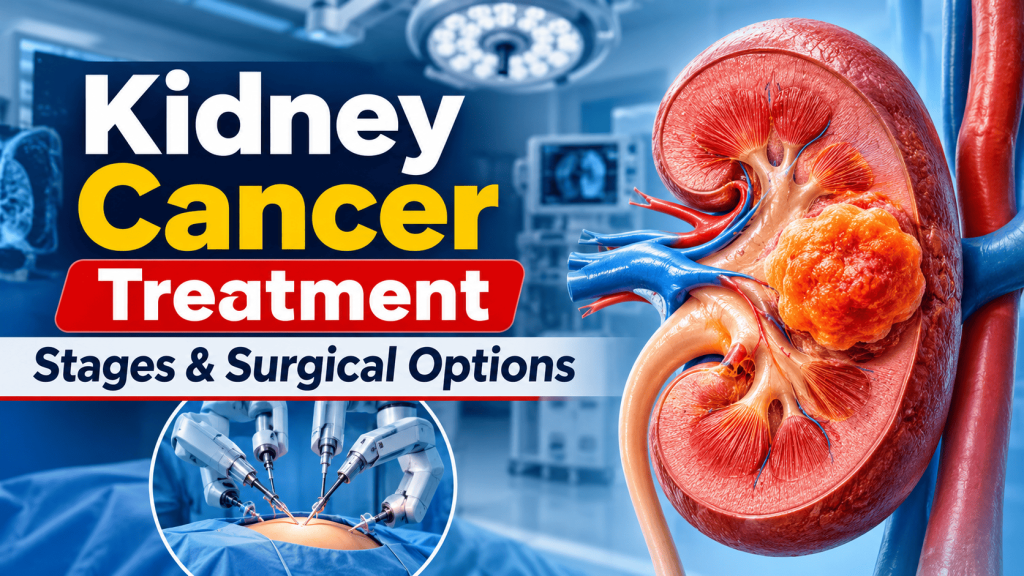
Kidney is an organ and there could be a mass in the kidney. This could be fatty, vascular, fluid filled or even pus. So, whenever a mass is detected in the kidney, it is very important to investigate and understand the nature of the mass.
Once understood, the kind of treatment required can be decided.
Dr. Yusuf Saifee (Consultant Urologist & Uro-Oncologist)
Kidney Cancer is now quite commonly diagnosed in our country. Fortunately, the treatment has evolved significantly.
We now have many options for treating kidney Cancer. These include laparoscopic and robotic kidney cancer surgery, kidney sparing surgery, targeted therapy and immunotherapy.
It is important to know about these options.
Investigations Required Before Kidney Cancer Treatment
Before treating kidney cancer, certain investigations are needed to understand the size of the tumor, it’s location, if it is cancerous and whether it has spread elsewhere.
CT abdominal
A contrast CT scan helps us understand the size, shape and position of the kidney tumor. We can understand the relationship of the tumor to surrounding vascular structures.
Other investigations may include:
- CT or X-ray of the chest.
- MRI scan.
- Bone scan if required.
- Blood tests.
- Urine tests.
- Kidney tumor biopsy (selective).
Not all patients will require all of the above investigations.
For example, not all patients will require a biopsy for kidney cancer if they are going to have surgery and their CT scan is very suggestive of kidney cancer.
The main aim of these investigations is to understand if the kidney mass is cancerous, how far it has spread and identify the best treatment for your patient.
How is Kidney Cancer Treated?
Kidney cancer treatment depends on the stage of the tumour.
Age, kidney function and general health will also play a big role.
Before we look at the treatment options, it is important to understand what staging means.
What are the 4 stages of Kidney Cancer?
Staging helps your doctor understand how much cancer you have, where it is and whether it has spread to other organs.
This helps to identify the best treatment for you.
Kidney Cancer is classified into 4 main stages.
Stage 1 Kidney Cancer
Tumour is 7cm or smaller.
There are various treatment options for stage 1 kidney cancer. These options will depend on the size of the tumour, where it is and the patients general health.
Active Surveillance
Small kidney tumours often grow very slowly. In some patients, especially the elderly or those with other serious medical conditions, the tumour will not produce any significant issues for a long time.
In these cases, active surveillance may be advised.
Active surveillance means that we will not operate immediately. Instead we will monitor the tumour regularly using imaging such as ultrasound, CT scan or MRI.
If the tumour grows, shows any worrying features or causes symptoms then treatment may be advised.
However, this is mainly considered for small kidney tumours. Especially those less than 2cm.
Partial Nephrectomy
Another important treatment is partial nephrectomy.
This involves removing the cancerous part of the kidney whilst leaving the remaining kidney intact.
This is very useful as we can remove the cancer.
For suitable stage 1 kidney tumours, partial nephrectomy will be the preferred treatment option. If this can be done it will be done.
This procedure is usually performed under general anaesthetic meaning the patient will be fully asleep.
Length of admission and recovery will vary depending on the type of surgery and patients condition.
Partial nephrectomy can be performed via open, laparoscopic or robotic surgery.
Robotic Partial Nephrectomy
Robotic partial nephrectomy is now a very advanced type of surgery for selected kidney cancers.
This involves the surgeon performing the operation through small incisions. They use robotic instruments and have a magnified three dimensional view.
The aim is to remove the cancerous part of the kidney however the surgeon will try to leave as much healthy kidney as possible.
Robotic surgery can make the surgeon’s job easier for precise dissection and suturing. This can be very useful in selected cases where the tumour is situated in a tricky area.
Not all patients will require robotic surgery.
Whether to perform open, laparoscopic or robotic partial nephrectomy will depend on the size of the tumour, location, kidney anatomy, patients condition and surgeons experience.
An important point to note is that partial nephrectomy may be very beneficial in patients with only one functional kidney or tumours in both kidneys. This is if it can be done safely.
This will help to preserve kidney function.
Cryoablation & Radiofrequency Ablation
If the patient is not suitable for surgery there are other treatment options.
Cryoablation involves using extremely cold temperatures to kill the tumour cells.
Radiofrequency ablation involves using heat to kill the tumour tissue.
This mainly involves selected small kidney tumours. Especially those who may not be fit for major surgery.
However, this may not be suitable for all kidney tumours. There is also a higher chance of local recurrence or re-treatment compared to surgery.
Stage 2 Kidney Cancer
Tumour is larger than 7cm but still contained within the kidney.
In this case, you may be advised to have radical nephrectomy.
What is Radical Nephrectomy?
Radical nephrectomy involves removing the entire kidney.
Depending on the tumour, surrounding tissue and lymph nodes may also have to be removed.
However, not all patients will need their lymph nodes removing.
Many patients are worried when they find out they need their entire kidney removing. However, in most cases you can live a normal life with one kidney. Especially if the other kidney is healthy and functioning well.
Radical nephrectomy can be performed via open, laparoscopic or robotic surgery.
Robotic Nephrectomy for Kidney Cancer
Robotic nephrectomy is another modern option for kidney cancer.
The surgeon will use robotic instruments to remove the affected kidney. This will be done through small incisions. This can help reduce post-operative pain and aid quicker recovery compared to open surgery in suitable patients.
However, the aim will always be to fully and safely remove the cancer.
Whether to perform laparoscopic, robotic or open surgery will depend on the tumour size, involvement of surrounding structures, vessels and patients condition.
Some tumours larger than 7cm may be suitable for partial nephrectomy in selected cases.
Any further treatment required?
Often in stage 2 kidney cancer, surgery will be the only treatment required. The tumour will be sent to the labs.
This will give information about what type of cancer you have, what grade and what stage it is. This helps your doctors understand your chances of the cancer coming back.
In selected patients with a higher chance of recurrence, adjuvant immunotherapy may be advised. This will usually be for around 1 year.
However, not all patients will require immunotherapy.
Stage 3 Kidney Cancer
The tumour may have spread to surrounding tissues or major veins. It may have also spread to surrounding lymph nodes.
The tumour can be various sizes and locations.
Before looking at treatment, it is important to understand what lymph nodes are.
Lymph nodes are small structures all over our body. They contain immune cells to help fight infection.
During infection, inflammation or cancer they can become enlarged.
Sometimes kidney cancer can spread to surrounding lymph nodes.
Surgery for Stage 3 Kidney Cancer
Surgery is usually the main treatment for stage 3 kidney cancer. If the tumour can be safely removed then surgery will be performed. Often radical nephrectomy will be performed. This involves removing the whole affected kidney.
If the cancer has spread into the renal vein or inferior vena cava then some extra surgery may be required to remove the tumour from these vessels.
Sometimes lymph nodes will also need to be removed, particularly if they look suspicious or enlarged on imaging.
This can be a more complex operation compared to early stage kidney cancer.
The type of surgery will depend on how far the tumour has spread and patient’s general health.
Immunotherapy
Some patients will have a higher chance of their cancer recurring. In selected high risk patients immunotherapy may be advised for around 1 year to reduce their chances of recurrence.
This will be decided after looking at the histopathology report and discussing what benefit and side effects there may be.
Some stage 3 kidney cancers cannot be fully removed. Other treatment options may be advised. This may involve immunotherapy, targeted therapy or both.
Targeted Therapy for Kidney Cancer
Targeted therapy is an important development in kidney cancer treatment.
Firstly it is important to understand how tumours grow. Like other tissues in our body they require a blood supply.
This provides the tumour with oxygen and nutrients. Some targeted therapy medications block the signals that help tumour grow new blood vessels.
These are often referred to as anti-angiogenic drugs.
By blocking these pathways, the tumour may grow slower. In some patients the tumour may even shrink.
Some targeted therapy medications come in tablet form. This makes it a convenient treatment.
However, they do have side effects.
They can cause high blood pressure, diarrhoea, tiredness, skin issues and other complications. Regular monitoring will be required.
Many patients with advanced kidney cancer can have good disease control using modern targeted therapy. Sometimes this can be for many years.
Immunotherapy for Kidney Cancer
Immunotherapy is another important development in kidney cancer treatment.
We have our own immune system in our bodies to protect us against infection and abnormal cells. However, cancer cells can develop ways to avoid being recognised by our immune system.
Immunotherapy medications, particularly immune checkpoint inhibitors, will help our immune system recognise and attack the cancer cells. This has really changed the way advanced kidney cancer can be treated.
Immunotherapy can now be used alone or in combination with targeted therapy or other immunotherapy medications. This depends on what type of cancer the patient has.
Some patients can have long lasting responses. However, immunotherapy can cause serious immune related side effects in organs such as the lungs, liver, intestine, thyroid or kidneys. Therefore treatment should be given under proper medical supervision.
Stage 4 Kidney Cancer
Stage 4 kidney cancer generally means that the cancer has spread outside of the kidney to other areas of the body. Or it may have spread significantly into surrounding structures.
Kidney cancer can spread to organs such as the lungs, liver, bones or brain.
Treatment will depend on how much the cancer has spread, the patients general health and the type of kidney cancer.
Most patients with metastatic kidney cancer will be treated with immunotherapy and targeted therapy.
Sometimes a combination of medication can be used.
Can surgery be performed?
Yes, in selected patients surgery may play a role in stage 4 kidney cancer.
If the cancer has only spread to a few areas then surgery may be considered.
In some patients the primary kidney tumour may also be removed.
This is known as cytoreductive nephrectomy.
However, not all patients with metastatic cancer will benefit from having their kidney removed. In many cases starting systemic treatment with immunotherapy or targeted therapy would be more appropriate.
This should be decided after proper evaluation by a multi-disciplinary cancer team.
What is Palliative Treatment?
You may have heard the term palliative treatment when speaking to doctors about your cancer.
Palliative treatment aims to reduce your symptoms and improve your quality of life.
The main aim is to help relieve your symptoms such as pain, tiredness, nausea, lack of appetite. It can be used at any stage of cancer and can be used alongside surgery, immunotherapy, targeted therapy etc.
The aim is to keep you as comfortable and active as possible.
Which is better for Kidney Cancer? Open, Laparoscopic or Robotic Surgery?
This is a common question asked by patients diagnosed with kidney cancer.
Now kidney cancer can be performed using various techniques. Open surgery involves making a large incision to remove the tumour or kidney.
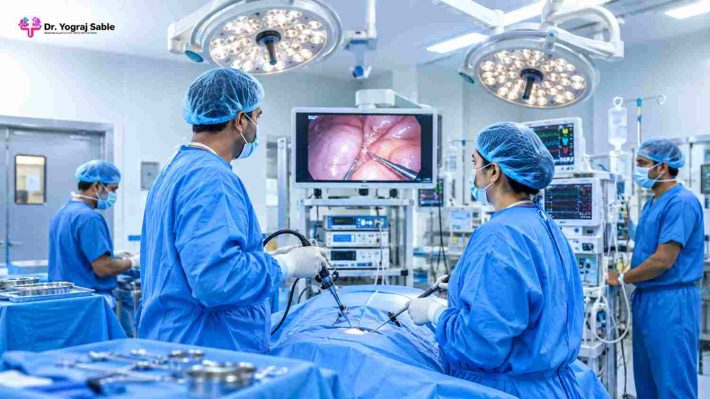
Laparoscopic surgery involves making small incisions and using a camera and special instruments to perform the operation.
Robotic kidney cancer surgery involves using robotic instruments. The surgeon will have a magnified 3D view. These instruments have a wider range of movement.
Laparoscopic and robotic surgery may offer benefits such as small incisions, less post-operative pain and quicker recovery. However,
The most important thing is to safely remove the cancer. Where possible, we will want to leave as much healthy kidney as possible.
Some patients may benefit from robotic partial nephrectomy. Whereas others may need laparoscopic or robotic nephrectomy. In some complex cases, open surgery may be the safest option.
The treatment should be chosen based on the tumour and patients condition.
Can Kidney Cancer be completely cured?
One of the first things patients will ask when diagnosed with kidney cancer is whether it can be completely cured. This will depend on the stage of cancer.
If detected early and contained to the kidney then often surgery will offer a very good chance of completely curing the cancer.
Even some locally advanced tumours can offer good long term outcomes with surgery and appropriate treatment.
Unfortunately complete cure is less common in metastatic kidney cancer. However, new medications such as immunotherapy and targeted therapy have significantly improved outcomes.
Some patients can live for several years with their cancer controlled.
Final Thoughts
It can be very scary for any patient and their family to be diagnosed with kidney cancer. However, it is important to realise kidney cancer is not the same in everyone.
Some tumours are very small and grow very slowly. Some can be removed with most of the kidney left intact. Some may require the kidney to be completely removed. Even if the cancer has spread to other organs there are treatment options.
The treatment of kidney cancer has evolved significantly with improvements in imaging, laparoscopic and robotic kidney cancer surgery, immunotherapy and targeted therapy. The most important thing is to correctly diagnose the disease, understand what stage it is and choose the correct treatment for your patient.
If a kidney lump/tumour has been detected on ultrasound/CT scan it is advisable to see a urologist/uro-oncologist for proper evaluation.
Dr. Yusuf Saifee
Consultant Urologist/Uro-Oncologist
Laparoscopic & Robotic Surgeon
Kidney Transplant Surgeon
Indore & Mumbai
This article is for general patient information. Decisions regarding treatment should be made after considering your imaging, kidney function, medical condition and other investigations.