
Kidney Cancer Survivor Story: Diagnosis, Partial Nephrectomy, and Returning to a Normal Life
Kidney cancer is something that you wouldn’t necessarily expect.
Some patients will have symptoms such as blood in the urine or back pain. However, many people will be diagnosed with kidney cancer as it is picked up during investigations.
Today I’m going to share the story of a young kidney cancer survivor.
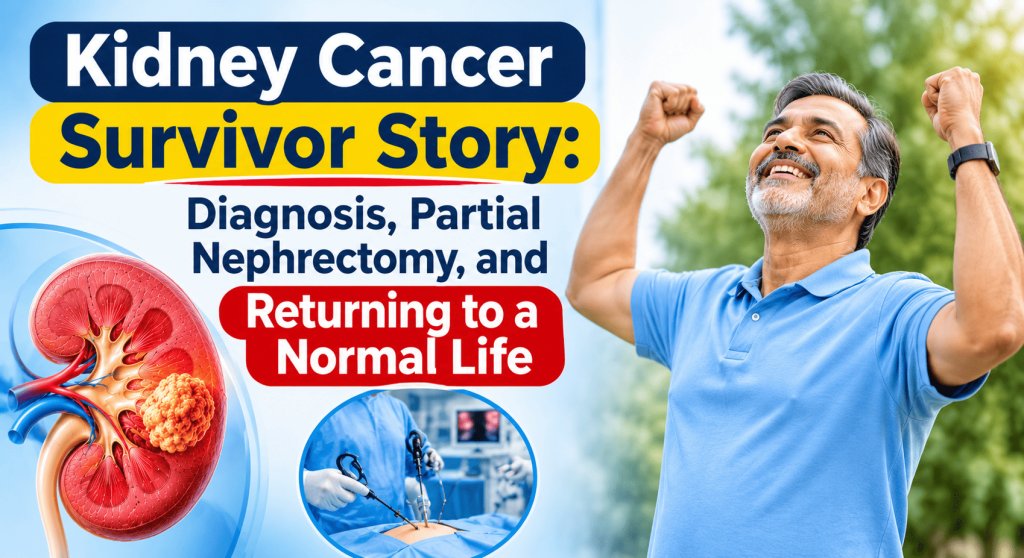
He was diagnosed with clear cell renal cell carcinoma, a type of kidney cancer, aged just 33.
He had investigations into a completely separate issue and discovered he had kidney cancer. He had a partial nephrectomy to remove the cancerous cells.
However, he did have some challenges.
There was anxiety surrounding the diagnosis, uncertainty around losing his kidney, infection after the procedure, and anxiety around having a history of cancer.
This patient story has been adapted into a conversation between a uro-oncologist and kidney cancer survivor. To help patients understand the process of diagnosis, surgery and recovery.
Dr. Yusuf Saifee: Can you tell us a bit about your story? When did you first realise you were unwell?
Mr. X: I would say about a year or so before I was diagnosed.
I was having issues with my stomach and my anxiety was higher than normal.
I knew there was an issue with my body but I just had to figure out what.
I Kept Ignoring the Symptoms
Dr. Yusuf Saifee: Did you immediately visit your GP?
Mr. X: No.
I think myself and a lot of other people will tend to push things to the back of our minds and think ‘with time it’ll get better’.
I would always try to ignore the symptoms or find excuses to.
I wasn’t really aware of what was going on until I went to A&E.
Dr. Yusuf Saifee: What happened?
Mr. X: I remember going home one night and couldn’t sleep.
I had issues with my stomach and knew there was something wrong.
I’d been tossing and turning all night.
The next morning I told my girlfriend ‘this is something different’ and had to go to A&E.
I didn’t have health insurance so going to A&E was always my last resort.
However, on this occasion I had no choice.
The CT Scan Revealed Something Unexpected
Mr. X: When they did the CT scan, they discovered my appendix was inflamed and I needed surgery to remove it.
However, they also told me ‘we can see something on your left kidney which needs attention’.
I was really taken back.
Dr. Yusuf Saifee: You went to hospital due to abdominal pain and appendicitis. During your CT scan they discovered a mass on your kidney.
This is something we see quite commonly.
Many kidney tumours are picked up incidentally. This means patients will have a scan (ultrasound/CT) for something else. Whilst doing this they discover a kidney mass.
Sometimes there may not be any symptoms relating to kidney cancer.
What happened after?
Mr. X: Honestly whilst I was laying in the bed awaiting surgery for my appendix I wasn’t worried about my appendix at all.
I was just thinking about my future.
Nobody gave me a definite answer as to what they saw.
They were all very vague.
They told me it could be cancer or a cyst.
Those few weeks between me hearing from the A&E doctors and seeing my urologist were really hard mentally.
My brain was going into overdrive.
I would have preferred to know what it was rather than wait and worry that it could be cancer. It was one of the most stressful times of my life.
The Urologist Told Me It Was Probably Kidney Cancer
Dr. Yusuf Saifee: How long until you saw a urologist?
Mr. X: I saw a urologist about 4 weeks later.
Whilst I was there with my family he looked at the scans and was fairly confident it was cancer.
He wanted to get me in for surgery asap.
Dr. Yusuf Saifee: I want to explain this to patients.
When we see a kidney mass on a contrast enhanced CT scan we can often be very suspicious that it could be renal cell carcinoma. Many times we will go straight to surgery.
However, not all kidney masses are cancerous and not all patients will require surgery straight away.
We look at the CT scan and see how big the tumour is, where it is in the kidney, how well the kidney is functioning, and other clinical factors. In this instance they decided to go ahead with surgery.
How did you feel emotionally?
Hearing You Have Cancer Changes Everything
Mr. X: I loved recording my appointments with my doctor.
When you hear the words ‘you have cancer’, you go pale. You can see yourself from a third party perspective.
Everything goes into slow motion and you’re just stood there whilst the room spins.
You’re trying to listen to what people are saying and trying to take in what your doctor is saying but honestly it’s going in one ear and out the other.
By recording my appointments I could listen back to them.
Having people there really helps.
You can ask them ‘what did he say about…?’ or ‘do you remember when he said…?’.
They can remind you what the doctor actually said.
I would definitely recommend if you have someone to go with you to ask them to go. If your doctor allows you to record it then do so.
Dr. Yusuf Saifee: This is an important point.
When you are diagnosed with cancer there is a lot to take in.
Your doctor may be talking about how big the tumour is, whether they can save your kidney, what type of surgery they are going to do and the risks involved. Having somebody with you from your family can help. Writing down questions to ask can also help.
Mr. X: : Would I Lose My Kidney?
Dr. Yusuf Saifee: Can you tell us a bit about your treatment?
Mr. X: I think the worst was not knowing if I was going to have my kidney or not.
My urologist told me before my operation ‘we’re going to go in there but I’m not leaving any cancer’.
He explained that there was a chance that when we removed the tumour and margins the rest of my kidney may not be suitable to save. He may have to remove my kidney.
He told me to be prepared.
I was preparing myself for surgery and was thinking ‘I may lose my whole kidney’.
Dr. Yusuf Saifee: This is a very important topic.
There are two main types of operations.
Partial nephrectomy – where we remove the tumour and leave the rest of your kidney.
Radical nephrectomy – where we remove the whole kidney.
We will always try to save the kidney if we can. We will do a partial nephrectomy if we can.
For example if a patient has a small tumour in one area of their kidney we can remove the tumour completely and leave the rest of their kidney.
However, sometimes the tumour can be very large or situated deep within the kidney or involve important structures. We may need to remove the whole kidney.
We always discuss with patients that there is a chance we may have to convert the planned partial nephrectomy to a radical nephrectomy.
Were they able to save my kidney?
Dr. Yusuf Saifee: What was the first thing you remembered after your operation?
Mr. X: The first thing I asked the nurses was ‘were they able to save it?’. She said ‘yes’.
I felt a huge weight off my chest.
The operation wasn’t as bad as I thought.
However, my abdomen was inflamed due to my appendix operation a few weeks prior.
This meant my recovery was a bit difficult.
Dr. Yusuf Saifee: The tumour was removed and your kidney was saved. This is what we aim to do with a partial nephrectomy. Partial nephrectomies can be done open, laparoscopically or robotically.
With a laparoscopic partial nephrectomy we make small incisions and use a camera and specialist instruments.
With a robotic partial nephrectomy we use a robotic system. This gives us a magnified 3D image and precise movements with the instruments. Both can be useful for certain kidney tumours.
However, the aim is to remove the cancer and leave as much of the kidney as possible.
I Had Some Issues
Dr. Yusuf Saifee: You mentioned you had some issues after your operation. What happened?
Mr. X: The main issue I had was an infection.
My recovery was delayed.
After my treatment I was sat in bed for at least 4 days. I noticed my abdomen wasn’t getting any better.
It was becoming more swollen and red.
I was also having mild fevers for a few days. I rang the hospital.
Probably during my second week I realised that I was on antibiotics and nothing was getting any better. I noticed some discharge from my incision.
I rang my urologist straight away and went back to see him. He examined me and gave me some further treatment.
After this everything started to improve. I had the infection for about 3 weeks (18-21 days). This was the hardest part of my recovery.
Dr. Yusuf Saifee: Sometimes patients can get an infection in their wound after surgery. This isn’t common but if you notice your wound is becoming increasingly red, swollen, you have a fever or discharge then please contact your surgeon.
Sometimes antibiotics will be enough. However, sometimes further investigation or drainage may be required.
How did you feel once your infection started to improve?
Mr. X: My swelling had gone down, my fevers had gone and I was able to move my body and twist without any pain.
However, mentally I was struggling.
The Cancer Was Gone But I Was Anxious
Dr. Yusuf Saifee: How did you feel in the weeks after your recovery?
Mr. X: This was when I started to struggle mentally.
I left my urologist and asked ‘what’s next?’. He told me ‘just take care of yourself’.
I wanted more specific answers.
After leaving I became very fussy about what I was putting into my body. I was using a different toothpaste, I was counting how much sodium I was having in every meal. I was eating different rice and even changing my deodorant. I was overthinking everything.
This made me even more stressed and anxious. This was the start of my health anxiety.
Dr. Yusuf Saifee: This can happen after treatment. Even though your tumour has been removed successfully you can still be anxious about it returning. You may become anxious about small symptoms.
A little back pain, stomach discomfort or abnormal bloods can make you anxious. However, not all symptoms mean your cancer has returned.
It is important to have follow up. After kidney cancer surgery we will usually advise follow up based on the stage and type of cancer, histopathology report and kidney function. This can include blood tests, kidney function tests and imaging.
How Did I Start to Feel Like I Was Recovering?
Dr. Yusuf Saifee: When did you start to feel like you were recovering?
Mr. X: I went to see a therapist. I had therapy for a year after my diagnosis and operation.
I credit a lot to seeing my therapist once a week. It helped me realise I can’t control everything but I can control the things I can. This made me feel like I had some control over my life again. It helped reduce my health anxiety.
Looking at my results and hearing the words ‘the cancer is gone’ and everything looks good helped me. I kept my reports in my office. Whenever I was feeling anxious about my health I would look at them. I would tell myself ‘you’re fine’. The numbers are telling you otherwise. The labs are telling you otherwise.
Life After My Operation
Dr. Yusuf Saifee: Can you tell us about your life now? If you were 100% healthy before your diagnosis how close do you feel you are now?
Mr. X: I would say I’m about 98%. I’ve completely changed my mindset. I’ve made a lot of lifestyle changes and I’m seeing positive impacts. I’m taking some risks in a good way.
When you get news like this your mindset changes. You realise your life can change in the blink of an eye. As a young adult with cancer I started to see life differently. If I want to do something I will do it. You never know how long you have left. Whatever your dreams are, whatever you want to do, go travelling, enjoy your life and spend time with people. Don’t put things off. I’m extremely grateful for every day.
Can Patients Live a Normal Life After Partial Nephrectomy?
Dr. Yusuf Saifee: A common question I get asked by kidney cancer patients is can they live a normal life after a partial nephrectomy. Many can. As we are saving the rest of the kidney many patients will still have good kidney function.
Patients who have a radical nephrectomy (whole kidney removed) can often live a normal life with one healthy kidney. However, it is important to have follow up.
We need to monitor kidney function, blood pressure and urine protein if indicated. We also need to monitor for cancer returning based on the stage and histopathology findings.
The key thing is not only completing the operation but ensuring they have appropriate follow up.
Finding Support from Other Kidney Cancer Survivors
Dr. Yusuf Saifee: Did you find it helpful to talk to other people who had kidney cancer?
Mr. X: Definitely.
I’m sure anybody going through a cancer diagnosis will go onto the internet and try to find somebody who has been through what they are going through. I did this.
I searched kidney cancer online and found the Kidney Cancer Association. I found a community. I found resources and people who had been through similar experiences. They have virtual seminars and you can ask questions. Everybody is there to help. This was very helpful for me.
Dr. Yusuf Saifee: This is another important part of recovery. Whilst medical treatment is important emotional support can help. Family members, support groups, mental health professionals and other cancer survivors can all help.
What Would You Say to Someone Recently Diagnosed with Kidney Cancer?
Dr. Yusuf Saifee: Imagine you meet somebody who has just been diagnosed with kidney cancer. They may have a million questions. If there is one thing you want them to take away from this what would it be?
Mr. X: Control your mind.
Don’t put yourself in situations. I know your body is going through a traumatic time but try to get your mind under control. I can’t tell you how many sleepless nights I had after my diagnosis due to the stress. You start to imagine the worst case scenarios which makes you even more anxious. Try to control what you can. Go through the process, talk to your doctors and get the treatment you need.