
What Is Endourology? A Comprehensive Guide to Advanced Minimally Invasive Treatments
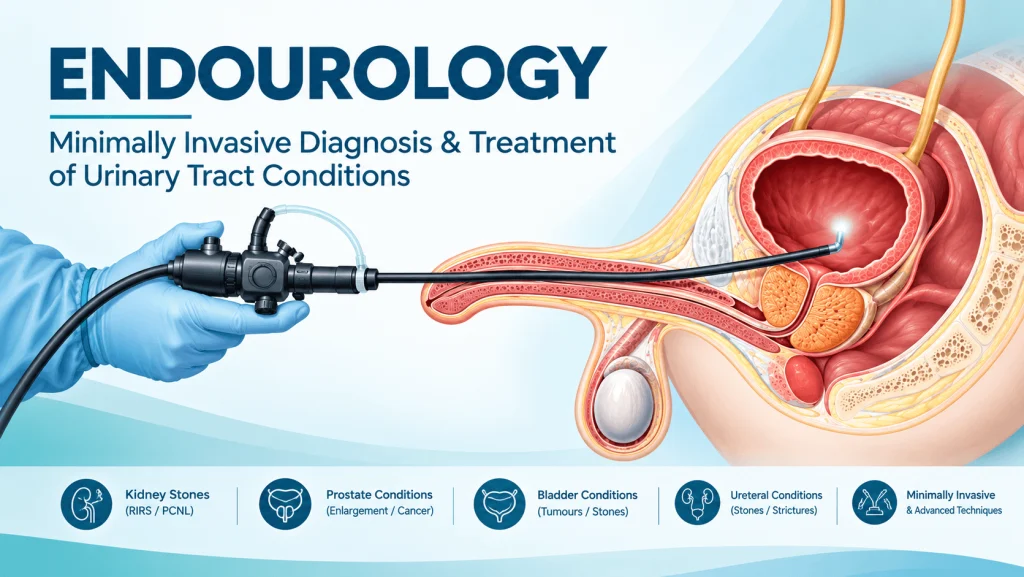
Table of Contents
- Introduction
- What Is Endourology?
- A Brief History of Endourology
- Common Endourological Procedures
- Conditions Treated Through Endourology
- Endourology vs Open Surgery vs Laparoscopy vs Robotic Surgery
- Benefits of Endourological Treatment
- What to Expect: Before, During, and After
- Possible Risks and Complications
- Who Is a Good Candidate?
- Recovery Timeline and Aftercare Tips
- Why the Surgeon’s Experience Matters
- Frequently Asked Questions
- Conclusion
Introduction
If you’ve been told you need surgery for a kidney stone, an enlarged prostate, or a growth in your bladder, the word “surgery” alone can feel intimidating. Images of long incisions, weeks of bed rest, and a painful recovery often come to mind first. But a lot of urology has quietly moved past that picture. A large share of procedures that used to require cutting open the abdomen or the flank are now done through the body’s own natural passages, using a thin camera and specialized instruments, with no external cut at all.
This branch of urology is called endourology, and it has changed what “kidney surgery” or “prostate surgery” actually means for most patients today. In this guide, we’ll walk through what endourology is, the procedures that fall under it, who benefits from it, and what the experience actually looks like from the day you’re diagnosed to the day you’re back to your normal routine.
What Is Endourology?
Endourology is the subspecialty of urology that deals with treating conditions inside the urinary tract using endoscopes—thin, flexible or rigid instruments fitted with a camera and light source—instead of open incisions. The word itself is a combination of “endo” (inside) and “urology”, and that’s really the simplest way to think about it: the surgeon works from inside the urinary system rather than cutting in from the outside.
Using natural body openings (or, in some cases, a small puncture no bigger than a pencil tip), the surgeon guides the endoscope through the urethra, bladder, or ureter or directly into the kidney. Once there, specialised tools — laser fibres, graspers, baskets, or resection loops — are passed through the same scope to break up stones, remove tissue, or take biopsies, all under direct visual guidance on a screen.
Because there’s no large incision, patients typically experience less pain, a shorter hospital stay, and a faster return to daily activities compared to traditional open surgery.
A Brief History of Endourology
Endourology as a distinct field started taking shape in the late 1970s and 1980s, when urologists began adapting endoscopic techniques from other specialties to access the kidney through a small puncture in the back — the earliest form of what we now call PCNL. Around the same time, fiber-optic technology made it possible to build thinner, more flexible scopes that could travel up through the ureter without an incision at all.
Over the following decades, three developments pushed the field forward dramatically: better fiber-optic and digital imaging, the holmium laser (which could fragment stones of almost any composition safely), and miniaturized instruments that could navigate the narrow, curved anatomy of the ureter and kidney without causing injury. What used to require a multi-day hospital stay and a visible scar can now, in many cases, be done as a same-day or overnight procedure.
Common Endourological Procedures
Endourology isn’t a single operation — it’s a family of procedures, each suited to a different part of the urinary tract and a different type of problem. Here are the ones you’re most likely to come across.
1. Ureteroscopy (URS)
Ureteroscopy involves passing a thin scope through the urethra and bladder, and then up into the ureter — the tube that carries urine from the kidney to the bladder. It’s most commonly used to locate and treat stones that are lodged in the ureter itself. Once the stone is visualized, a laser fiber is passed through the same scope to break it into fragments small enough to pass naturally or be removed with a small basket. URS is typically done under general or spinal anesthesia and, in straightforward cases, patients go home the same day or the next morning2. Retrograde Intrarenal Surgery (RIRS)
2. Retrograde Intrarenal Surgery (RIRS)
RIRS takes the same idea as ureteroscopy one step further, using a flexible scope that can bend and navigate all the way up into the kidney itself. This makes it possible to treat stones sitting inside the kidney — not just the ureter — without any incision at all. A laser fiber fragments the stone into dust-like particles, which either pass out naturally over the following days or are retrieved directly. RIRS has become a preferred option for small-to-moderate kidney stones, particularly when a patient wants to avoid even the small puncture used in PCNL.
3. Percutaneous Nephrolithotomy (PCNL)
For larger or more complex kidney stones, PCNL remains the gold standard. Instead of going in through the urethra, the surgeon creates a small tunnel — about the width of a little finger — directly through the skin of the back into the kidney, under X-ray or ultrasound guidance. A scope is passed through this tract to break up and remove the stone, often in a single sitting even when the stone is large or has an irregular, branching shape (known as a staghorn stone). Despite involving a small skin puncture, PCNL is still classified as minimally invasive and heals in a fraction of the time that open stone surgery would take.
4. Transurethral Resection of the Prostate (TURP)
TURP is one of the most established endourological procedures and is used to treat benign prostatic hyperplasia (BPH) — a non-cancerous enlargement of the prostate that causes urinary blockage, especially in men over 50. A resectoscope is passed through the urethra, and the surgeon trims away the excess prostate tissue that’s obstructing urine flow, without any cut on the skin. It remains one of the most reliable long-term solutions for moderate-to-severe BPH symptoms.
5. Transurethral Resection of Bladder Tumor (TURBT)
TURBT is used both to diagnose and treat bladder tumors. A scope is passed through the urethra into the bladder, where visible tumors are shaved away layer by layer and sent for pathology. It’s usually the first step for anyone with blood in the urine that turns out to be caused by a bladder growth, and it plays a central role in staging bladder cancer accurately.
6. Cystoscopy
Cystoscopy is the simplest and most frequently performed endourological procedure — a direct visual examination of the bladder and urethra using a thin scope. It’s used to investigate blood in the urine, recurring urinary infections, unexplained bladder symptoms, or to follow up on previously treated bladder tumors. Many cystoscopies can even be done in a clinic setting under local anesthesia, without needing an operating room at all.
Conditions Treated Through Endourology
Endourological techniques are used across a wide range of urinary tract conditions, including:
- Kidney stones of nearly all sizes and locations, from small ureteral stones to large staghorn calculi
- Ureteral strictures (narrowing of the ureter) that block normal urine flow
- Benign prostatic hyperplasia (BPH), causing weak flow, frequent urination, or incomplete emptying
- Bladder tumors, both for diagnosis and initial treatment
- Upper tract urothelial tumors — growths inside the kidney’s collecting system or ureter
- Recurrent urinary tract infections linked to structural causes that need direct visualization
- Unexplained hematuria (blood in urine), where a cystoscopy helps identify the source
Endourology vs Open Surgery vs Laparoscopy vs Robotic Surgery
Patients are often confused about how endourology differs from laparoscopic or robotic surgery — understandably, since all three are described as “minimally invasive.” The distinction comes down to the route the surgeon takes to reach the problem.
Open surgery involves a traditional incision through the skin and muscle to directly access the kidney, bladder, or prostate. It’s still used for select complex cases but has largely been replaced for most routine procedures.
Laparoscopic and robotic surgery also avoid a large incision, but they work from outside the urinary tract — through small ports in the abdominal wall, using instruments (or a robotic system, in the case of robotic surgery) to operate on organs like the kidney or prostate from the outer surface. These techniques are typically used when an organ, or part of one, needs to be removed or reconstructed — for example, a partial or complete kidney removal for cancer, or a robotic prostatectomy.
Endourology, by contrast, works from inside the urinary tract itself, through the body’s natural openings or a single small puncture, and is generally reserved for conditions confined to the inner lining or cavity of the urinary system — stones, strictures, and superficial tumors, for instance.
In short: if the problem is inside the urinary passage itself, endourology is usually the first choice. If the problem involves removing or reconstructing the organ from outside, laparoscopic or robotic surgery takes over.
Benefits of Endourological Treatment
Endourological procedures share a set of advantages that explain why they’ve become the default approach for so many urinary conditions:
- No external incision (or, at most, a puncture the size of a pinhole for PCNL), which means minimal scarring
- Less post-operative pain compared to open surgery, often manageable with oral medication alone
- Shorter hospital stay — many procedures are done as day-care surgery or with a single overnight stay
- Faster return to work and daily activities, often within a few days to a week
- Lower risk of infection due to the smaller access point
- High success rates, particularly with modern laser and imaging technology
- Preserves healthy tissue, since the surgeon can target the stone or tumor precisely without disturbing surrounding structures
What to Expect: Before, During, and After
Before the Procedure
Your surgeon will typically order imaging — an ultrasound, CT scan, or X-ray — to map out the exact size, number, and location of the stone or growth. Routine blood and urine tests check kidney function and rule out an active infection, which usually needs to be treated first. You’ll be asked to fast for a few hours before the procedure and to stop certain blood-thinning medications in advance, if applicable.
During the Procedure
Most endourological procedures are performed under general or spinal anesthesia, so you won’t feel or be aware of anything during the surgery. The procedure itself usually takes anywhere from 30 minutes to about two hours, depending on the complexity and size of the stone or tumor. In many cases, a temporary stent — a thin, soft tube — is placed in the ureter afterward to keep it open while it heals; this is removed in a quick follow-up visit a week or two later.
After the Procedure
Recovery in the hospital is typically short. Many patients undergoing ureteroscopy or RIRS go home the same day or the following morning, while PCNL may involve a one- to two-day stay depending on stone complexity. Mild discomfort, some blood in the urine for a few days, and an urge to urinate frequently (if a stent is placed) are all expected and usually settle within a week.
Possible Risks and Complications
Like any surgical procedure, endourology carries some risk, though serious complications are uncommon with an experienced surgeon. These can include:
- Mild bleeding or blood in the urine for a few days
- Urinary tract infection
- Temporary discomfort or urgency caused by a ureteral stent
- Incomplete stone clearance, occasionally requiring a second, staged procedure for very large or complex stones
- Rare injury to the ureter or surrounding structures
Your surgeon will go over the specific risks relevant to your case, your stone size, and your overall health before the procedure.
Who Is a Good Candidate?
Most people with stones confined to the kidney or ureter, or with BPH and bladder growths limited to the inner lining, are reasonable candidates for an endourological approach. Factors that help determine the right procedure include stone size and location, kidney anatomy, whether an infection is present, and any prior urinary tract surgery. Very large, complex, or cancerous conditions that extend beyond the inner lining of the urinary tract may instead need laparoscopic, robotic, or open surgery — which is why accurate imaging and a proper pre-procedure evaluation matter so much.
Recovery Timeline and Aftercare Tips
Recovery after most endourological procedures is measured in days, not weeks. A general (though individual results vary) timeline looks like this:
- Day 1–2: Rest at home, mild discomfort, plenty of fluids to help flush the urinary tract
- Day 3–7: Gradual return to light activities; stent-related discomfort (if placed) starts easing
- Week 2: Stent removal (if applicable) at a short outpatient visit
- Week 2–4: Most patients resume normal work and physical activity, depending on the procedure
A few practical tips help recovery go smoothly: drink more water than usual to help clear any remaining stone fragments and reduce infection risk, avoid heavy lifting or strenuous exercise until your surgeon clears you, take prescribed medications on schedule, and attend your follow-up visit and imaging as advised — even if you’re feeling completely fine.
Why the Surgeon’s Experience Matters
Endourological procedures depend heavily on precision, and outcomes can vary noticeably based on a surgeon’s hands-on experience with these techniques. Navigating a flexible scope through the twists of the ureter, judging exactly how much laser energy to use on a stone without injuring the surrounding tissue, or safely creating a percutaneous tract into the kidney are skills built over hundreds of procedures, not something that transfers automatically from general surgical training.
When you’re choosing a surgeon for a kidney stone, prostate, or bladder procedure, it’s worth asking directly about their experience with the specific technique being recommended — how many similar cases they’ve handled, and what technology (laser type, imaging, scope generation) they use. A surgeon who regularly performs RIRS, PCNL, and related procedures is generally better positioned to handle unexpected findings during the operation and to minimize the chance of needing a repeat procedure.
Frequently Asked Questions
Is endourology painful?
Most patients report only mild discomfort after the procedure, usually well managed with oral pain relief. Since there’s no large incision, pain levels are considerably lower than with open surgery.
How long does it take to recover from RIRS or PCNL?
Most patients are back to light routine activity within a week, and to full normal activity within two to four weeks, depending on the specific procedure and stent placement.
Will I need a stent after the procedure?
Not always — it depends on stone size, location, and how the ureter looks during the procedure. When a stent is placed, it’s temporary and removed in a quick follow-up visit.
Is endourology safe for large kidney stones?
Yes. Larger or more complex stones, including staghorn stones, are commonly treated with PCNL, which is specifically designed for bigger stone burdens.
Does endourology leave a scar?
Ureteroscopy and RIRS leave no visible scar at all, since the scope travels through natural passages. PCNL leaves a single small puncture mark, usually just a few millimeters.
How is endourology different from robotic surgery?
Endourology works from inside the urinary tract through natural openings or a tiny puncture, while robotic surgery works from outside the body through small abdominal ports, typically for removing or reconstructing an organ.
Conclusion
Endourology has quietly become one of the most patient-friendly advances in modern urology. Conditions that once meant open surgery, a large scar, and weeks of recovery — kidney stones, prostate enlargement, bladder tumors — can now often be treated from inside the urinary tract itself, with little to no visible incision and a much faster return to normal life.
That said, the right procedure for you depends on your specific anatomy, stone size or tumor characteristics, and overall health — which is why an accurate diagnosis and a conversation with an experienced urologist matter more than the general description of any single technique. If you’re dealing with a kidney stone, urinary blockage, or any of the symptoms discussed above, getting evaluated early makes both the diagnosis and the treatment considerably simpler.