
Our services
Request an appointment
Reserve your spot with our medical team in just minutes.
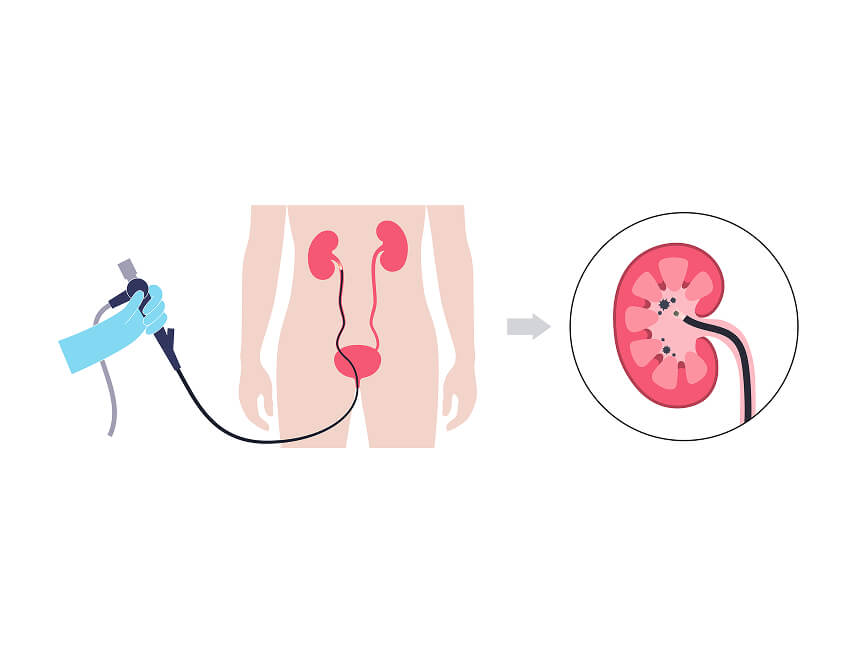
What Is Retrograde Intrarenal Surgery (RIRS) and How Does It Help Treat Kidney Stones?
Retrograde Intrarenal Surgery, commonly known as RIRS, is a minimally invasive endourological procedure designed to treat kidney stones and certain other intrarenal conditions without the need for large incisions or open surgery.
Unlike traditional techniques that require cut‑downs or punctures, RIRS uses the natural urinary passage to reach stones inside the kidney with a flexible telescope, giving urologists direct visual access to stones and other abnormalities.
This makes it an ideal option for stones that are difficult to reach with shockwave lithotripsy or when other treatments have failed.
RIRS is increasingly chosen because it combines high precision with faster recovery, less pain, and shorter hospital stays than many more invasive options.
This procedure has transformed kidney surgery because it reduces patient discomfort, speeds up recovery, minimizes scarring, and lowers the risk of post-surgical complications. Over the past decade, laparoscopic techniques have become the preferred choice for urologists worldwide, including for complex procedures like partial nephrectomy for kidney tumors, reconstructive kidney surgery, and removal of large kidney stones.
Kidney surgery is not something to delay. Untreated kidney conditions can progress silently, causing irreversible damage to kidney function, infection, or complications affecting the entire urinary system. Laparoscopic surgery addresses these problems effectively, preserving as much healthy kidney tissue as possible.
How Is RIRS Performed?
In RIRS, a flexible ureteroscope, a thin, flexible tube with a camera and light, is inserted through the urethra, bladder, and ureter to reach the inner part of the kidney. Once the scope is in place, the surgeon can:
-
Visualise stones directly within the kidney’s collecting system without any external cuts.
-
Break the stones with laser energy (laser lithotripsy) or similar tools into small fragments.
-
Retrieve fragments using tiny baskets or allow them to pass naturally after fragmentation.
-
Depending on the individual case, a temporary stent may be placed to help the kidney drain smoothly during healing.
This procedure typically takes place under general or spinal anesthesia to ensure the patient is comfortable and pain‑free throughout.
Who Is a Good Candidate for RIRS?
RIRS is usually recommended when:
-
Kidney stones are moderate in size (often up to about 2 cm) or located in hard‑to‑reach areas of the kidney.
-
Other therapies like shockwave lithotripsy have not worked or are unsuitable.
-
The patient has anatomical variations, bleeding risks, or medical conditions that make percutaneous approaches riskier.
-
Stones have recurred or remain after previous surgery.
RIRS can also be adapted successfully for patients who are on anticoagulants, elderly patients, or those with anatomical challenges because it avoids large external cuts.
What Are the Main Benefits of RIRS?
Because it is performed through the body’s natural urinary channels, RIRS offers multiple advantages:
-
No external incisions or scars, making it a truly scar‑free procedure.
-
Less pain and discomfort after surgery compared with open or percutaneous procedures.
-
Shorter hospital stays and faster recovery, with many patients going home the same or next day.
-
Reduced risk of bleeding and complications due to its minimally invasive nature.
-
High success rates for stones in various kidney locations.
These benefits make RIRS one of the leading options for treating renal stones, particularly in patients who want effective, less invasive care.
What About Risks and Recovery After RIRS?
While RIRS is generally safe, it is not completely without risks. Some patients may experience mild urinary discomfort, temporary blood in the urine, or low‑grade fever shortly after the procedure. Infection and bleeding are rare but possible, especially if stones are infected or the procedure is prolonged.
Recovery is usually quick, most patients can return to light activity within a few days to a week. Follow‑up imaging is often done to ensure complete stone clearance.
RIRS is a highly effective, minimally invasive stone removal option with strong success rates, a low complication profile, and minimal recovery time for suitable candidates.