
Our services
Request an appointment
Reserve your spot with our medical team in just minutes.
What Is Bladder Cancer and How Common Is It?
Bladder cancer is a disease in which abnormal cells grow uncontrollably within the lining of the urinary bladder. It is one of the more common cancers of the urinary tract, particularly affecting men, who are two to three times more likely to develop it than women.
Most cases are diagnosed after the age of 55, although it can occur earlier in people with significant risk factors.
With improved awareness and better diagnostic tools such as ultrasound, cystoscopy, and CT urography, bladder cancer can be detected earlier. Early diagnosis plays a crucial role in successful treatment and long-term outcomes.
Understanding the basics of bladder cancer helps patients recognise symptoms early and seek timely care.
What Are the Different Names and Types of Bladder Cancer?
Bladder cancer is often referred to by different medical names based on the type of cells involved and how the tumour behaves.
Urothelial (Transitional Cell) Carcinoma
Urothelial carcinoma, also known as transitional cell carcinoma, is the most common type of bladder cancer. It originates from the urothelial cells that line the inner surface of the bladder and are designed to stretch as the bladder fills and empties.
Urothelial carcinoma can range from low-grade, slow-growing tumours to high-grade, aggressive forms that have a higher likelihood of invading the bladder muscle and spreading to other parts of the body.
Squamous Cell Carcinoma
Squamous cell carcinoma of the bladder is relatively uncommon and is typically associated with chronic bladder irritation and inflammation. Long-term factors such as recurrent urinary tract infections, prolonged catheter use, bladder stones, or parasitic infections can lead to cellular changes that increase cancer risk.
This is often diagnosed at a more advanced stage, as symptoms may develop gradually, and it tends to be more aggressive than urothelial carcinoma.
Adenocarcinoma
Adenocarcinoma of the bladder is a rare form of bladder cancer that arises from glandular or mucus-producing cells within the bladder lining. These cells are not normally prominent in the bladder but may develop as a result of chronic inflammation or congenital abnormalities.
Adenocarcinomas often present as invasive tumours and are typically diagnosed at later stages, which can make treatment more complex.
Other Rare Types
Several other rare forms of bladder cancer exist, including small cell carcinoma and sarcoma. Small cell carcinoma is a highly aggressive tumour that behaves similarly to small cell lung cancer and is often associated with early spread beyond the bladder.
Sarcomas originate from connective tissues such as muscle or blood vessels within the bladder and are extremely rare. Due to their aggressive nature and limited prevalence, these cancers often require specialised and multidisciplinary treatment approaches.
Correct identification of the tumour type is essential for choosing the right treatment strategy.
What Causes Bladder Cancer and Who Is at Higher Risk?
The exact cause of bladder cancer is not always clear, but certain risk factors are strongly linked to its development.
Smoking is the single most important risk factor. Tobacco smoke contains carcinogenic chemicals that enter the bloodstream and are filtered by the kidneys, eventually collecting in the bladder where they damage the lining over time.
Occupational exposure to chemicals used in industries such as dye, rubber, leather, textile, metal, printing, and paint manufacturing also increases risk. Long-term exposure to these substances allows harmful compounds to accumulate in the bladder.
Certain chemotherapy drugs, especially cyclophosphamide, and previous pelvic radiation therapy can increase the likelihood of bladder cancer years later. Chronic bladder irritation due to recurrent infections, long-term catheter use, or bladder stones also plays a role.
Identifying and reducing modifiable risk factors is an important preventive step.
What Symptoms Can Indicate Bladder Cancer?
Symptoms of bladder cancer can vary from mild urinary changes to more noticeable warning signs. In many cases, the disease presents early, allowing prompt evaluation.
The most common symptom is painless blood in the urine, which may appear intermittently and sometimes with clots. Increased urinary frequency, urgency, and burning during urination are also frequently reported.
Some patients experience difficulty holding urine, sudden urges to urinate, or incomplete bladder emptying. As the disease progresses, fatigue and general weakness may develop.
Any unexplained urinary symptom, especially blood in urine, should never be ignored.
How Is Bladder Cancer Diagnosed Accurately?
Diagnosing bladder cancer involves a combination of laboratory tests, imaging, and direct visual examination of the bladder.
Urine Tests
Urine analysis helps detect blood, infection, and abnormal cells. Urine cytology is used to identify cancer cells shed into the urine.
Imaging Studies
Ultrasound of the kidneys, ureters, and bladder helps detect masses and associated abnormalities. CT urography provides detailed information about tumour size, depth of invasion, and involvement of surrounding structures.
Cystoscopy and Biopsy
Cystoscopy is the gold-standard diagnostic test. A thin telescope is passed through the urethra to directly inspect the bladder lining. If a suspicious lesion is seen, a biopsy is taken for histopathological confirmation.
Biopsy confirmation is essential before planning definitive treatment.
Are All Bladder Tumours Cancerous?
Not all bladder tumours are malignant. Some growths may be benign, but they often resemble cancerous tumours on imaging or cystoscopy.
Because benign and malignant tumours can look similar, biopsy is mandatory to determine the true nature of the lesion. Even benign tumours require close follow-up, as recurrence is possible.
Histological examination remains the only reliable way to differentiate tumour types.
How Is Bladder Cancer Classified Based on Invasion?
Bladder cancer is broadly classified based on how deeply it penetrates the bladder wall.
Non-Muscle Invasive Bladder Cancer
This is the most common form, where cancer remains confined to the inner lining of the bladder. These tumours have a good prognosis but require long-term surveillance due to recurrence risk.
Muscle-Invasive Bladder Cancer
In this form, cancer spreads into the bladder muscle. It is more aggressive and has a higher risk of spreading to other organs.
The depth of invasion is one of the most critical factors influencing treatment decisions.
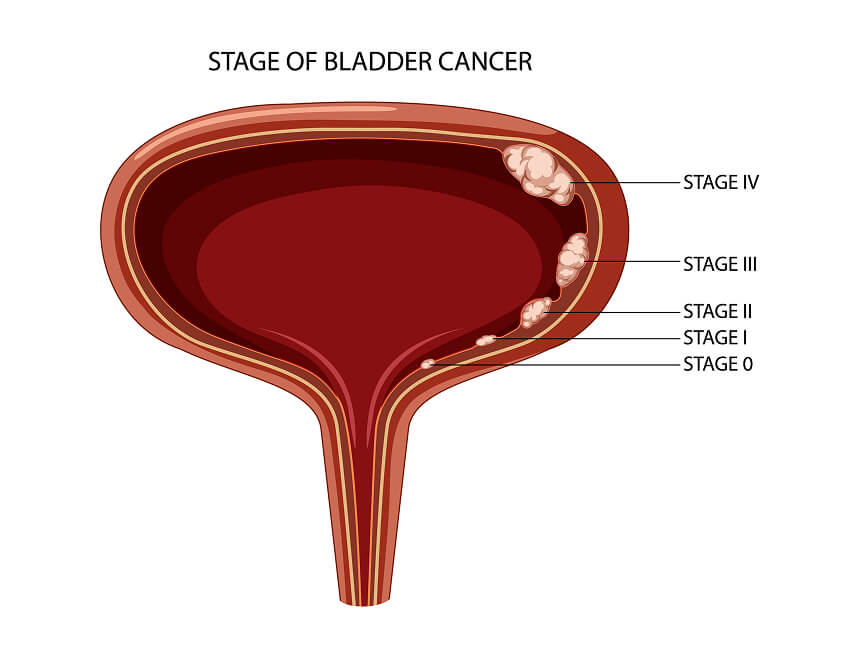
What Are the Stages of Bladder Cancer and What Do They Mean?
Staging describes how far the cancer has grown or spread.
Lower-stage cancers are easier to treat and have better outcomes.
What Does the Grade of Bladder Cancer Indicate?
Grade refers to how abnormal the cancer cells appear under the microscope.
Low-grade tumours resemble normal bladder cells and grow slowly. High-grade tumours appear more abnormal, grow rapidly, and are more likely to recur or spread.
Bladder Cancer Grades help predict behaviour and decide intensity of treatment and follow-up.
How Is Bladder Cancer Treated Today?
Bladder cancer treatment is planned by a multidisciplinary team and tailored to the stage, grade, and patient health.
Transurethral Resection of Bladder Tumour (TURBT)
Transurethral resection of bladder tumour is the initial and most common treatment for suspected bladder cancer. The procedure is performed endoscopically using a cystoscope inserted through the urethra, eliminating the need for external incisions.
In non-muscle-invasive bladder cancer, TURBT may be sufficient as initial therapy, although repeat procedures may be required to manage recurrence or assess tumour depth.
Intravesical Therapy
Intravesical therapy involves the direct instillation of medication into the bladder via a catheter following TURBT. This approach allows high local drug concentrations while minimising systemic side effects.
Intravesical chemotherapy is often used to reduce the risk of tumour recurrence, while intravesical immunotherapy, most commonly bacillus Calmette-Guérin (BCG), is used in higher-risk non-muscle-invasive disease to decrease both recurrence and progression. Treatment is typically administered in induction and maintenance schedules.
Radical Cystectomy
Radical cystectomy is the standard treatment for muscle-invasive bladder cancer and for certain high-risk non-muscle-invasive tumours that do not respond to conservative therapy. The procedure involves complete removal of the bladder and, in some cases, surrounding organs depending on the patient’s sex.
Following bladder removal, urinary diversion is required, which may be achieved through an ileal conduit, continent urinary reservoir, or neobladder reconstruction. Radical cystectomy is a major operation and requires careful patient selection and postoperative management.
Partial Cystectomy
Partial cystectomy involves removal of only a portion of the bladder containing the tumour while preserving the remaining bladder. This option is suitable only in carefully selected patients, typically when the tumour is solitary, located in an accessible area, and not associated with widespread disease.
Preserving bladder function can offer quality-of-life benefits, but close surveillance is required due to the risk of recurrence in the remaining bladder tissue.
Radiotherapy and Systemic Therapy
Radiotherapy may be used as part of bladder-preserving treatment strategies or for patients who are not suitable surgical candidates. Systemic therapies, including chemotherapy and newer immunotherapy agents such as immune checkpoint inhibitors, play an important role in advanced, recurrent, or metastatic bladder cancer.
These treatments may be used alone or in combination with surgery or radiation to improve disease control and survival outcomes. Advances in systemic therapy have significantly expanded treatment options for patients with advanced disease.
Selecting the treatment depends on balancing cancer control with quality of life.
Can Bladder Cancer Be Prevented or Detected Early?
While bladder cancer cannot always be prevented, certain measures reduce risk significantly. Quitting smoking, minimising chemical exposure, and treating recurrent urinary infections promptly are important steps.
Regular follow-up after treatment is critical, as bladder cancer has a tendency to recur. Surveillance cystoscopy allows early detection and treatment of recurrence.
What Is the Prognosis for Bladder Cancer Patients?
Prognosis depends on the stage and grade at diagnosis and response to treatment. Early-stage bladder cancer has an excellent outcome when treated promptly and monitored regularly.
Advanced stages carry a more guarded prognosis but can still be managed effectively with modern multimodal therapies.
Final Takeaway
Bladder cancer is a treatable and often manageable disease when detected early. With advances in endoscopic surgery, intravesical therapy, immunotherapy, and personalised care, patients today have better outcomes and improved quality of life.